

Projects up for Vote
Read through the projects, choose the one you believe in, and cast your vote.
The shortlist.
Read the problem, the solution, and the impact. Then decide.

HOLY
COW
In Gaibandha, families lean on farming that the climate keeps disrupting - and when the harvest suffers, so does the income. Women and young people have the fewest options of all. There's steady local demand for fresh milk, but most families can't afford the upfront cost of a dairy cow, let alone the training, vet care and market access needed to make it pay.
Fifteen households receive a subsidised high-yield dairy cow, professional training and ongoing veterinary support. Direct partnerships with Milk Vita, BRAC-Aarong and Pran let farmers sell straight to processors - no middlemen. Manure feeds organic farming, and a cost-sharing model builds real ownership so the enterprise lasts beyond the project.
This project will:
- Give 15 families a stable daily income from milk
- Raise household earnings by BDT 15,000-18,000 a month in lactation periods
- Produce around 36,000 litres of milk a year
- Build lasting livestock assets through breeding
Women gain greater control over productive resources, and households grow more resilient through diversified income and better farming practices.
WATT A
DIFFERENCE
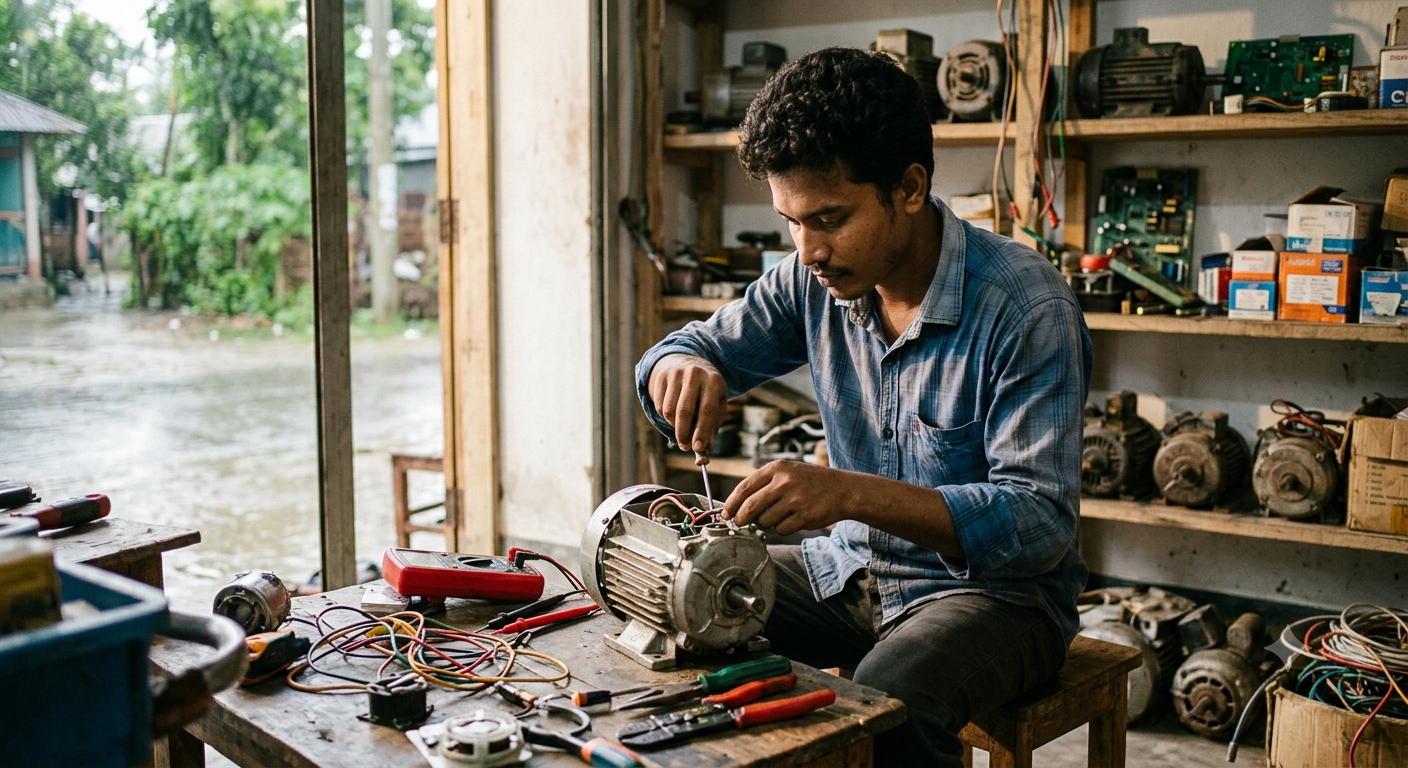
In Koyra, Khulna, cyclones and riverbank erosion have worn down the fishing and farming young people once relied on. Most scrape by on BDT 5,000-8,000 a month of seasonal work. Meanwhile, homes are filling with appliances and solar kit that need fixing - but the area has no trained electricians, and youth have no route into the trade.
A four-month vocational programme trains 20 young people in electrical wiring, appliance repair and plumbing - classroom learning, hands-on practice and a one-month apprenticeship in local workshops. Graduates get professional toolkits, pricing and client-handling guidance, and referral partnerships with retailers and contractors so they can start earning straight away.
This project will:
- Turn 20 unemployed young people into certified freelance electricians
- Give each a net monthly income of around BDT 16,000
- Create up to 1,400 repair services a month for the community
- Strengthen households against climate-driven economic shocks
With savings support, mentorship and market links, it builds self-employment that lasts and feeds back into the local economy.

WORM THIS
WAY
Along the Sundarbans fringe in Koyra, repeated cyclones, erosion and rising salinity have left young people underemployed, most surviving on BDT 5,000-7,000 a month. Salty, tired soil has farmers hungry for organic compost - and the raw organic waste is everywhere. What's missing is the skill, kit and market access to turn that waste into a business.
Twenty young people set up household vermicompost enterprises, each with a full starter package - earthworms, tools and packaging. They get technical training, business and quality-control guidance, and direct market links to farmers, seed shops and nurseries. Turning organic waste into compost - and breeding worms to resell - makes a low-cost, low-risk green enterprise.
This project will help 20 young people become self-employed green entrepreneurs, each earning an estimated BDT 46,800 net a year. Together they'll:
- Produce around 28,800 kg of organic compost a year
- Improve local soil health
- Cut dependence on chemical fertilisers
- Strengthen climate-smart farming in the region
As the worms multiply and profits reinvest, each enterprise can scale - a genuine circular-economy model.
Compare the projects.
Three projects. Three missions. You decide which matters most right now.
| 01 · Holy Cow | 02 · Watt a Difference | 03 · Worm This Way | |
|---|---|---|---|
| Focus | Dairy farming income | Electrician training | Vermicompost enterprise |
| Location | Gaibandha | Koyra, Khulna | Koyra, Khulna |
| Direct reach | 15 households | 20 young people | 20 young people |
| Est. income | BDT 15-18k / month | BDT 16k / month net | BDT 46,800 / year net |
| Key output | 36,000 L milk / year | 1,400 services / month | 28,800 kg compost / year |
| Key outcome | Stable income + livestock assets | Certified freelance electricians | Green enterprise + healthier soil |
| Scalability | Scalable rural dairy model | Self-employment + local economy | Circular-economy model |
| Budget | £4,279 | £4,238 | £4,192 |
Cast
your
vote.
You've read the projects. You've seen the numbers. Now it's time. Community members vote - and the winning project gets funded.
Vote now →Not a member yet? Join the community to get your vote.